
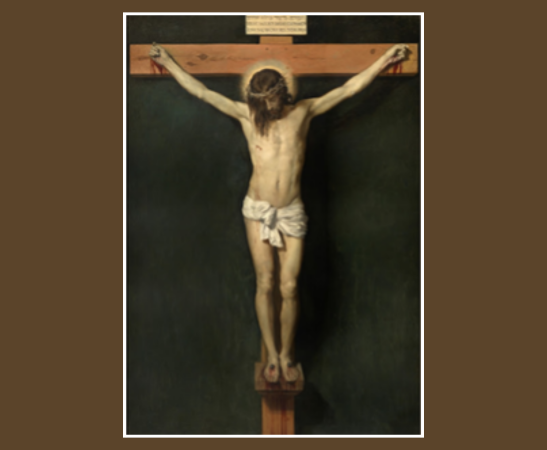
The Book of numbers 21:4-9 gives us the background to John 3:14-15. God had punished the Israelites with a plague of serpents; yet, heeding their pleas for mercy, he instructed Moses to make a bronze serpent and raise it up high on a pole. By gazing upon this image, victims of snakebite were healed. God’s provision in the desert of physical life for the Israelites foreshadowed God’s provision at Calvary of eternal life for all peoples. As Jesus said: ‘and I, when I am lifted up from the earth, will draw all men to myself.’ Not only was Jesus ‘lifted up’ in pain and shame on the cross, but also ‘lifted up’ in a cloud when he ascended to glory. In the Creed we declare, ‘For our sake he was crucified under Pontius Pilate…’ but we also affirm ‘…he ascended into heaven and is seated at the right hand of the Father.’ (Painting by Velazquez)
In ancient basilicas and Romanesque art, the cross is represented in a festive manner – often spangled with gems – and Christ is enthroned upon it in royal robes, crowned with gems instead of thorns. The focus here is not the sin that necessitated the cross or the suffering produced by the cross, but the effects of the cross – salvation, reconciliation, peace, eternal life.
Yet, while salvation is freely available, it must be appropriated by faith. Just as the Israelites gazed upon the bronze serpent we too stand at the foot of the cross and gaze upon the Crucified One now exalted as the Christ. As Paul declares: ‘For the message about the cross is foolishness to those who are perishing, but to us who are being saved it is the power of God.’